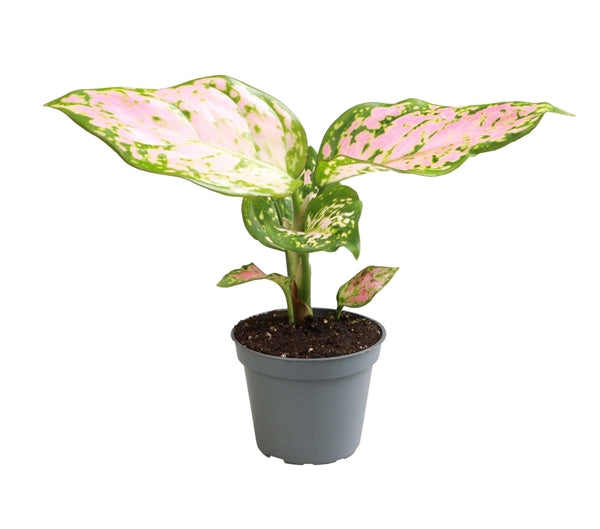
Pot diameter: 6cm
Care for Aglaonema Red Valentine
Aglaonema 'Red Valentine' is one of the most stunning houseplants thanks to its distinctive pinkish-red coloration. Unlike the robust philodendron, it's a more compact beauty that grows slowly and forms dense clusters of leaves, brightening any darker corner.
Watering
Aglaonemas are generally very tolerant, but 'Red Valentine' thrives on balance.
When to water: Let the substrate dry out to approximately the top half of the pot between waterings. Reduce watering even more in winter.
Beware of extremes: This plant is susceptible to root rot if overwatered (leaves turn yellow and soft). Conversely, prolonged dryness will cause lower leaves to drop.
Water: Soft, standing water at room temperature is best.
Light
While Aglaonema is known as a shade plant, colorful cultivars like 'Red Valentine' have their specifics.
Placement: It needs bright, diffused light to maintain its vibrant pink color.
Lack of light: In complete shade, the color will fade, and the leaves will be more green.
Direct sun: Beware of harsh midday rays, which could irreversibly burn the delicate colored leaves.
Temperature and Air
Ideal temperature: 18–25 °C. It does not tolerate drops below 15 °C and is very sensitive to drafts and cold air from windows during winter ventilation.
Humidity: Unlike many other tropical plants, it tolerates normal dry indoor air well. However, higher humidity (around 60%) will benefit it – the leaves will be shinier.
Cleanliness: Regularly wipe the leaves with a damp cloth. This will not only remove dust but also highlight their beautiful patterns.
Fertilization and Growth
Fertilization: From March to September, fertilize once a month with a balanced liquid fertilizer for houseplants. Since it grows slowly, it doesn't need as strong doses as large philodendrons.
Growth: It has a shrub-like, compact habit. Over time, it may form inflorescences (spathes), which are recommended to be removed so that the plant does not expend energy needed for its leaves.
Substrate
The key to success is maximum airiness so that the roots can breathe.
Composition: A mix for houseplants with a high proportion of perlite and pine bark (in a ratio of approximately 2:1:1).
Drainage: Aglaonemas do not tolerate standing water at the roots, so a layer of expanded clay at the bottom of the pot with drainage holes is an absolute necessity.