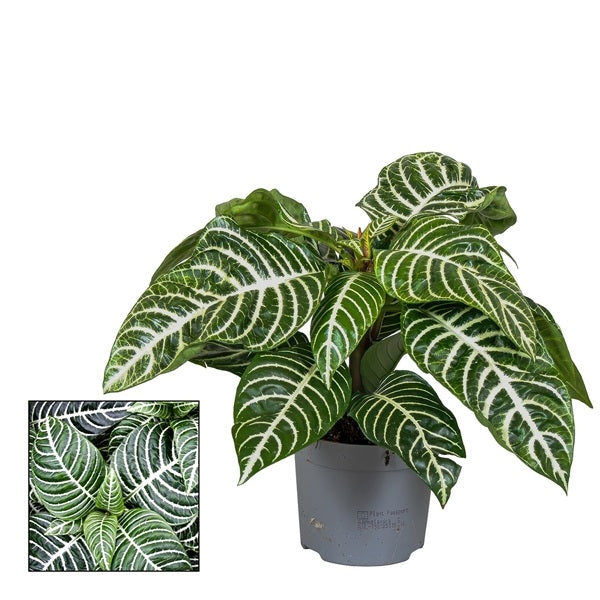
Pot diameter: 13cm
Aphelandra squarrosa Botanica Care
Aphelandra squarrosa 'Botanica' (also known as "Afelandra" or "Zebra Plant") is a visually dramatic plant that combines deep green leaves with striking white veins. However, compared to the low-maintenance Aglaonema, it is a bit more of a "diva," requiring precise conditions to keep its leaves fresh and prevent them from browning.
Watering
Aphelandra is very sensitive to water – it cannot tolerate drought, but also not waterlogged soil.
When to water: Keep the substrate consistently slightly moist, but never wet. Once the top 1-2 cm of the substrate dries out, it's time to water.
Beware of extremes: If left to dry out completely, the leaves will droop and may start to fall off. Overwatering, on the other hand, causes stem and root rot.
Water: Use exclusively lukewarm and soft water (preferably rainwater or boiled water). Cold tap water can shock the plant.
Light
This plant needs a lot of energy to maintain its contrasting veins and potentially bloom with yellow flowers.
Placement: Very bright, but indirect light is ideal. It will thrive well on an east or west-facing window.
Lack of light: The plant loses its compactness, stems stretch, and the white veins may start to turn green.
Direct sun: Sharp midday sun will burn the leaves within a few hours. It needs protection with a curtain.
Temperature and Air
Ideal temperature: 18–24 °C. It does not tolerate large temperature fluctuations or drafts. The temperature should never drop below 15 °C.
Humidity: This is the key to success. Aphelandra requires high air humidity (above 60%). It is ideal for placing near a humidifier or on a pebble tray with moist pebbles (leca).
Cleanliness: The leaves are glossy, and dust on them is visible. Regularly wipe them with a soft, damp cloth so the plant can breathe freely.
Fertilization and Growth
Fertilization: From spring to late summer, fertilize every 14 days with liquid fertilizer for flowering houseplants to encourage the formation of its typical yellow "spikes."
Growth: It has an upright growth habit. After flowering, it is good to prune the plant lightly to maintain a dense and compact shape and prevent the lower parts of the stem from becoming bare.
Substrate
It needs a rich but very well-draining mix.
Composition: A mixture of quality peat-based substrate with an admixture of perlite or sand for better water drainage.
Drainage: An absolute necessity. Without good drainage at the bottom of the pot, Aphelandra very quickly succumbs to root rot.