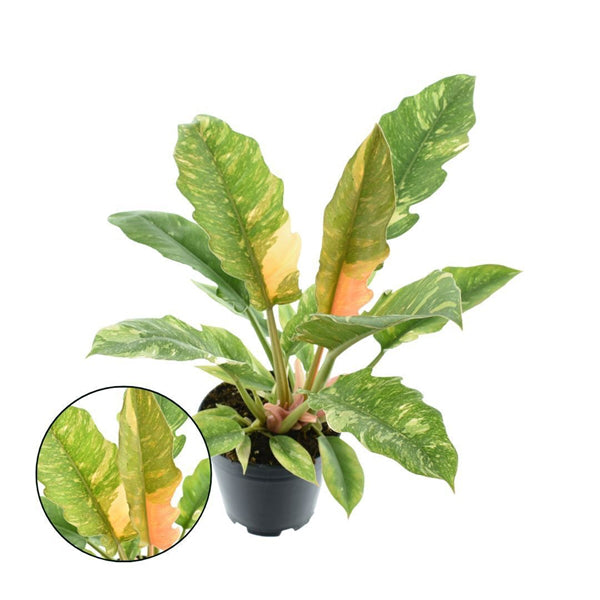
Pot diameter 14cm
Philodendron 'Ring of Fire' Care
Philodendron 'Ring of Fire' is a collector's gem that requires a little more attention than common philodendrons, especially to maintain its five-color variegation. However, due to its slow growth and unique appearance, it is one of the most rewarding plants in any collection.
Watering
Water your 'Ring of Fire' when the top 1/3 to 1/2 of the soil in the pot is dry. This plant grows slowly, so it uses less water than aggressive growing species. Be careful not to overwater, as its sensitive roots are prone to root rot. Use room temperature, dechlorinated or rainwater; chlorine and cold can cause spots on the light-colored parts of the leaves.
Light
Light is the most important factor for this plant. It thrives best in very bright, but indirect light (filtered light).
Important: High light intensity is essential to maintain its vibrant variegation (orange and red tones). If there is insufficient light, new leaves will start to turn green (lose variegation).
Beware of scorching: The white and cream parts of the leaves do not contain chlorophyll and are very susceptible to sunburn from direct midday sun. An east-facing window or a west-facing window with sheer curtains is ideal.
Temperature and Humidity
Ideal temperature: 18–27 °C.
Cold: As a tropical plant, it does not tolerate cold below 15 °C or drafts.
Humidity: The ideal humidity is 60–80%. Although it can survive in normal household dryness (around 50%), higher humidity will ensure that new leaves unfurl more easily and do not have dry tips. It thrives near a humidifier. Misting is not very beneficial for variegated leaves (it can cause mold); a tray with expanded clay pebbles and water is a better option.
Fertilization
During the growing season (spring–autumn), fertilize every 14 to 30 days with a liquid fertilizer for ornamental plants at half strength. Since it grows slowly, do not over-fertilize to avoid burning the roots.
Substrate and Support
Substrate: Must be extremely airy and well-draining. An aroid mix (a blend of pine bark, perlite, coco coir chips, and a little peat) is ideal.
Support: For healthy growth and larger leaves, a moss or coir pole is recommended. The plant will attach itself to it with its aerial roots, providing stability.