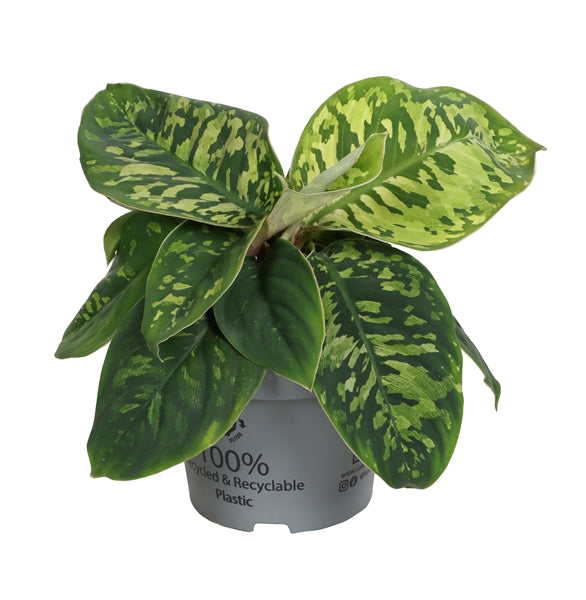
Pot diameter 12cm
Homalomena wallisii 'Camouflage' Care
Homalomena wallisii 'Camouflage' is a low, compact plant that earned its name thanks to the fascinating pattern on its leaves. They look as if someone hand-painted them with various shades of olive, emerald, and silvery colors. It is a close relative of aglaonemas and anthuriums but has a much more exotic and collectible appearance.
Watering
Homalomena is a bit of a "drinker" when it comes to water, but it must not sit in mud.
When to water: The substrate should be constantly slightly moist, but not wet. Water as soon as the top 2 cm of the substrate dries out.
Beware of extremes: Unlike dracaenas, Homalomena will not forgive dryness – its leaves will quickly wilt, and their edges will irreversibly turn brown. Overwatering, on the other hand, causes rapid yellowing of leaves from the center.
Water: Always use room temperature, standing water. Cold tap water can cause spots on the leaves.
Light
Its natural habitat is the undergrowth of tropical rainforests, which determines its requirements.
Placement: Medium-bright, diffused light is ideal. It also thrives in partial shade, making it an ideal plant for north-facing rooms.
Lack of light: Growth will stop, and the "camouflage" pattern will be less distinct.
Direct sun: Is taboo for it. Even short exposure to direct sun will immediately scorch the leaves and destroy their color.
Temperature and Air
Ideal temperature: 18–24 °C. It does not tolerate cold; as soon as the temperature drops below 15 °C, the plant will start to suffer.
Humidity: Homalomena loves high air humidity. It does not thrive in a dry apartment – the tips of its leaves will start to dry out. A humidifier, misting, or placing the pot on a tray with moist pebbles will help.
Cleanliness: The leaves are slightly leathery, so occasionally wipe them with a damp cloth to highlight their contrasting pattern.
Fertilization and Growth
Fertilization: From spring to autumn, fertilize once every 14–21 days with a balanced houseplant fertilizer at half strength. Do not fertilize at all in winter.
Growth: It grows more in width than in height. It forms a dense, low clump of leaves on short petioles. It is a great choice for a desk or coffee table where you can admire it.
Substrate
It needs a rich, humus-rich, yet airy mix.
Composition: An ideal mix is houseplant substrate, peat, and crushed bark or perlite (in a 2:1:1 ratio). The substrate must "breathe" even when moist.
Drainage: A layer of expanded clay at the bottom is a must so that excess water can freely drain into the saucer.