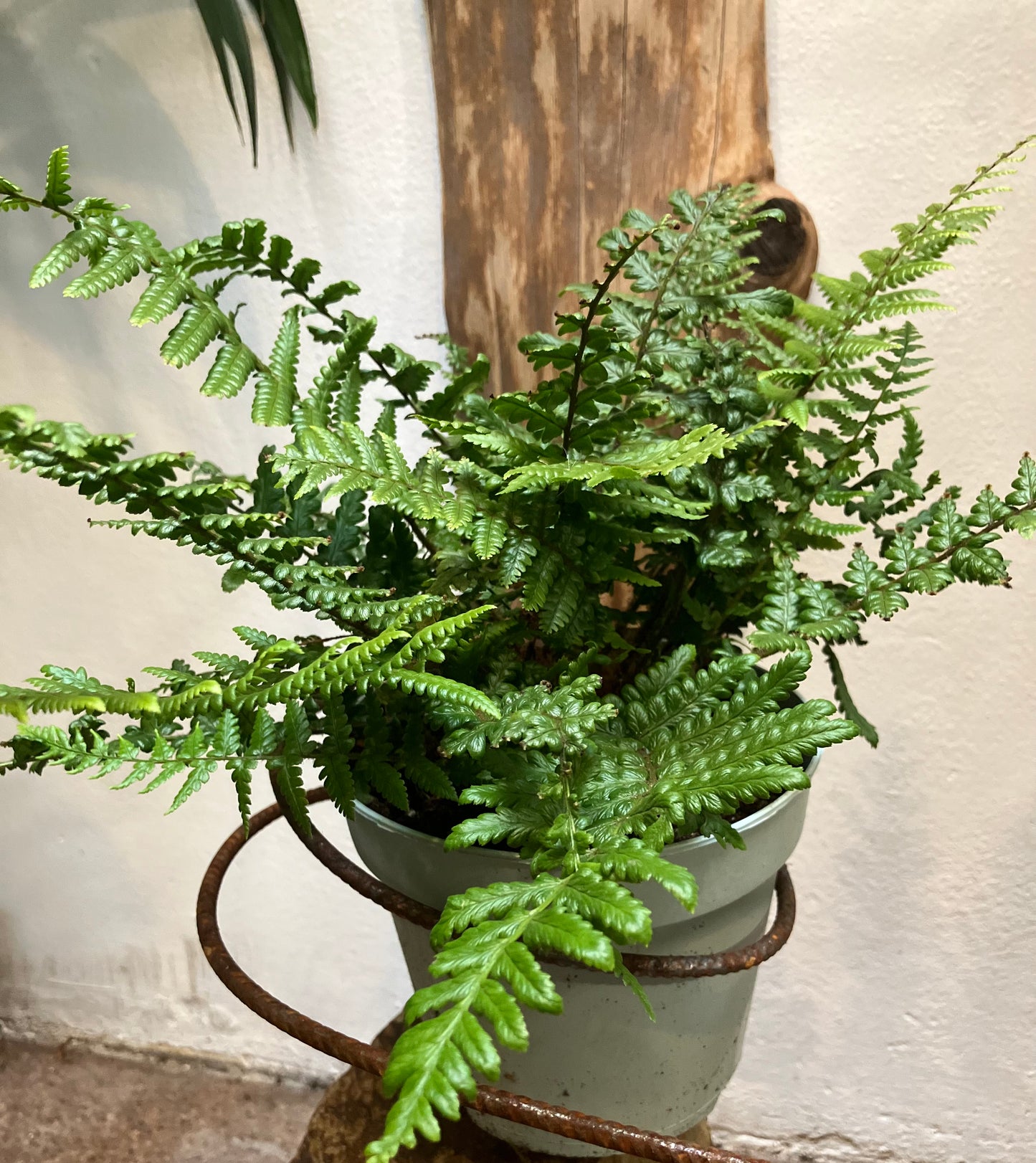
Pot diameter 17cm
Care for Dryopteris affinis (Scaly Male Fern)
Dryopteris affinis is a robust and elegant fern that brings the atmosphere of a primeval forest to the garden or cooler interior. Its firm, bipinnate fronds with characteristic golden-brown scales on the stipes are more resilient than other ferns, but still require a specific approach.
Watering
Keep the substrate constantly slightly moist, but never waterlogged. Ferns do not tolerate complete drying out of the root ball, which leads to irreversible wilting of the fronds.
Sign: If the tips of the fronds start to turn brown and curl, the plant is suffering from drought.
Water: Soft, rainwater or stagnant water is best. Ferns are sensitive to calcium and chlorine in fresh tap water.
Caution: Reduce watering slightly during the winter, but do not let the substrate dry out completely.
Light
As a typical forest plant, it loves shade to partial shade. Direct sun is its greatest enemy, capable of scorching the fronds in a single afternoon.
An ideal location is a north-facing side or deeper shade under tree canopies or in a room corner.
It can even tolerate deep shade where most other plants struggle. It grows faster in bright indirect light, but the frond color may be lighter.
Temperature and Air
Hardiness: Dryopteris affinis is an outdoor, fully frost-hardy fern (in our climate, it often overwinters as evergreen or semi-evergreen).
Humidity: Requires high air humidity (above 60%). It will suffer in dry apartment air.
Tip: If growing in a pot, place it on a saucer with moist pebbles (expanded clay) or near a water feature. It loves misting its fronds with a fine spray.
Fertilization
Ferns are less demanding in nutrients than fast-growing Monstera. Too much fertilizer can burn their delicate roots.
Fertilize once a month from April to August.
Use half the recommended dose of liquid fertilizer for green plants or a special fertilizer for ferns.
Do not fertilize at all in winter; the plant is resting.
Substrate
It needs a humus-rich, loose, and slightly acidic soil that retains moisture well but is also airy.
Ideal mix: Leaf mold (or peat), quality garden compost, and a little sand or perlite for aeration.
In heavy, clay soil, there is a risk of rhizome rot; in purely sandy soil, it dries out too quickly.